

Slikk is a 60-minute delivery quick-commerce fashion and lifestyle app, that delivers trendy apparel, footwear, beauty products, accessories, and home decor items.
Founders of the Slikk noticed a huge trust gap inside the traditional e-commerce business (especially in fashion & lifestyle), with common customers concerns like quality of the item, mismatching/wrong products, return & refund delays, 4-10 delivery time period, etc.
The business opportunity founded by Slikk was to bridge the gap between traditional e-commerce operational flaws and fulfilling the growing demand in customers of instant gratification and quick-lifestyle trends with emerging quick-commerce demands across industries.
When Slikk saw the business opportunity, it started positioning itself as a channel for last-minute action takers platform for fashion & lifestyle.
By using marketing strategies like, “60-Minute Delivery, Try & Buy and welcome offers”, to attract and serve a unique purpose by building itself as a brand.
But to understand more, I needed answers for below several questions:
Why Slikk’s business model would sustain itself fundamentally?
Let’s break this down…
As an ongoing new wave of societal restructuring reforms are evolving, so does the evolution in the traditional markets is changing rapidly as well.
We are noticing an emerging experimentation with local markets blending heavily with emerging powerful technology from smart AI tools and social media opportunities which are powering all sizes of businesses to grow beyond by the method of e-commerce and so on.
So, today I decided to dissect a new brand & see a structural-breakdown of an emerging quick-commerce fashion & lifestyle app brand named “Slikk” [formerly “Slikk Club”]; to understand its purpose, origin and its future endeavors and challenges about the foreseeable future.
What Is The Purpose?
Slikk is a growing quick-commerce fashion and lifestyle app that curates and delivers trendy apparel, footwear, beauty products, accessories, and home decor products, etc., all in under 60 minutes.
BUT THE QUESTION IS, we already have a traditional setup for the fashion & lifestyle laid out which is growing at a steady 9% CAGR, and a report from The CMAI & 1Lattice, tells us that 83% of the sales still happens completely offline, keeping away the impact of e-commerce.
As we all know, India as a consumer market has uniquely ranging preferences in their choices. Just like the diversity in the culture of India holds in its demographic traditions.
Then why do we need another e-commerce brand?
Well, I think I have derived an answer about what part of the business ’Slikk’ is focusing at.
Slikk is majorly focusing on the young generation targeting Gen Z and young millennials which spans among 14 to 45 years old individuals.
These are the generations which bridge the transition into a fully digital world, shifting from adapters of technology to becoming digital natives.
Since, young individuals have become drivers of new age technology, it is changing their decision-making-ability from the core understanding, and letting them take decisions relying entirely on instant gratification, peer-to-peer verification, and value-driven engagement.
As even me being me a Gen Z, I want the exact fit if I find something cooler and valuable while scrolling, and I do try to find it in the internet. Of course, generally what almost everybody does, I guess.
That’s exactly where Slikk found its value proposition…
Slikk positioned itself in the gap between consumer’s desire and purchasing that item as soon as possible.
Marketing strategies they’re using to scale the business:
- Try & Buy: Allowing customers to try products upon delivery before finalizing the purchase, that experience that drives aggressive word-of-mouth for organic growth.
- Targeting the “intent-Action Gap”: Ads drives focus heavily immediate lifestyle needs & instant gratification.
- Hyper-Personalization: Platform uses predictive AI to curate a list of 100-200 localized, fast-moving items per neighborhood micro-market for marketing.
- Retention Marketing: Hight-retention users are funneled into structured loyalty groups like the “Explorer” and “Trendsetter” programs, for rewards and exclusive perks to solidify brand community.
- Rebranding: In September 2026, the brand underwent a major rebrand to reposition shifting its identity from a speed-driven quick-commerce service to a “fashion-first” discovery destination.
Slikk primarily partners with emerging & mid-sized D2C brands like, The Souled Store, Snitch, Bewakoof, etc., and operates the demand through nearby dark stores to fulfill the customer’s delivery.
A potential disruptive idea: To partner with above D2C brands, Slikk came up with a great idea saving the profits to cut return orders logistical expenses (which is about ~30% in traditional e-commerce).
By Slikk’s ‘Try & Buy’ feature, where a delivery partner waits outside while the consumer tries out the fits and can keep what is required and can return the rest to delivery partner.
This method cancelled out the whole extra hassle for businesses to track and get the product back, sometimes maybe with unexpected damage or missing products.
Where It Started?
The company was founded in 2024, headquarters based in Bengaluru (India) by Om Prakash Swami, Akshay Gulati and Bipin Kumar Singh.
Currently, its operational services are exclusively available in Bengaluru city (covers areas like HSR Layout, Koramangala, Indiranagar, and Sarjapur).
Within 2 years the company has raised $13.5 million from across 20+ investors of total 3 rounds of funding.
What are Slikk’s future plans?
The competition for Slikk would not be easy to reach its way up. Since it has legacy giants like Myntra, Ajio, Flipkart, Amazon, etc., can be noticing the market patterns.
As we have noticed the recent quick-commerce competition in groceries / 10-mins delivery business, started off with Blinkit in 2023 and today we have around 126 active companies with similar services, including all smalls and giants of the industry.
Yet, rather than spreading its services into other major cities, Slikk decides to stand and deepen its roots at its home market Bengaluru (India) for 2026.
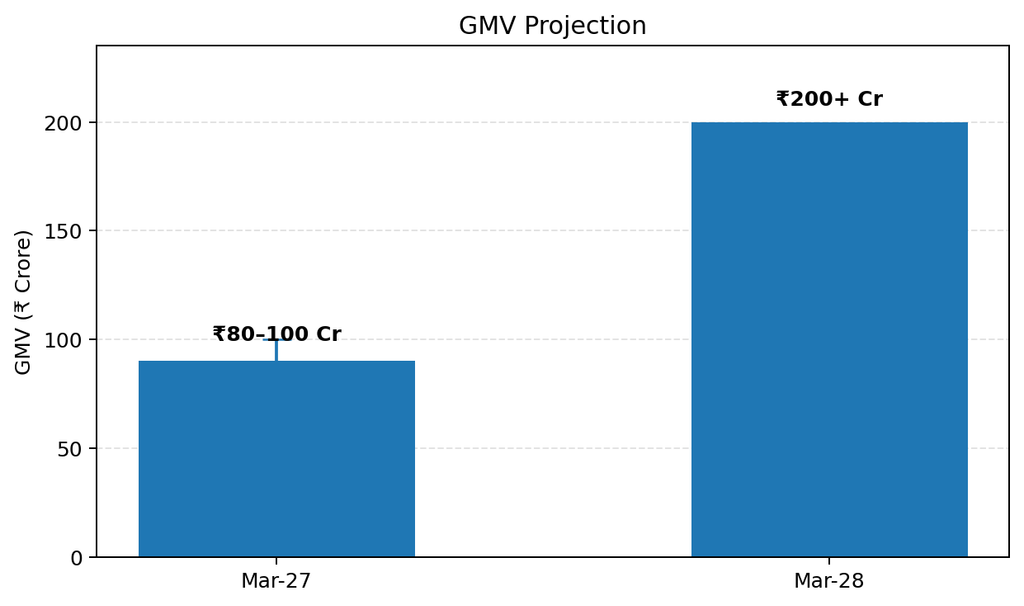
Its near-term goal has been set for March 2027 to reach 80-100 crores in monthly GMV and capture 10-15% of Bengaluru’s total online fashion & lifestyle market share (Current revenue not disclosed).
It also has a long-term target to hit upwards of ₹200 crore in monthly GMV within next 24 months as it captures 20-25% of Bengaluru’s total online fashion & lifestyle market share.
Similarly, Slikk intends to address the entire instant lifestyle needs of its demographic, hence it aggressively plans to expand into the direction of other related categories like beauty & personal care, footwear, handbags & jewelry, accessories & wearables.
Aiming to grow its partners brands from 700 to 2,000 brands to ramp up the inventory over the next fiscal year.
As I said above, Slikk wants to build a steady hand business from Bengaluru, and plans to expand into other major Indian cities.
So far, Slikk is expecting phase 1 of launching operations in Delhi NCR and Mumbai in the first half of 2027
Whereas, expecting its phase 2 entering the major Tier-1 hubs including Hyderabad, Pune, and Kolkata, with an ultimate target of hitting a combined ₹400-500 crore in monthly GMV across these cities.
Guess what, these all strategies and frameworks helped Slikk to grow by 25x all within 1 year.
What Are The Challenges To Face?
Now that we have discussed about Slikk’s genius idea and strategies it is using to build the brand
We cannot just oversee its day-to-day business challenges in its operational, economics, and competitive challenges as it scales.
It can face challenges like…
While waiting for customers to try on clothes builds trust, but handling rejections, on-the-spot returns, and cleaning/re-staging worn or handled inventory raises last-mile labor costs.
Managing dark stores with rapid 60-minutes dispatch is significantly more expensive than traditional warehouse-to-door e-commerce.
Future investments in expanding dark stores across pincodes requires heavy capital, while maintaining strict margins on low-to-medium fashion items.
Keeping up the competition with industry giants like Zepto, Blinkit, and Swiggy Instamart, etc., or other fashion-focused horizontal giants have massive capital comes as another unavoidable huge battle.
Assumptions can also have a thought, if the onboarded fashion brands decides to build their own dark-stores networks or sign exclusive deals with larger marketplaces, then Slikk’s curated catalog advantage could weaken.
Maintaining a 60-minutes delivery puts intense pressure on delivery partners, leading to attrition, high delivery-fleet costs, or safety concerns during peak traffic in dense populated cities like Bengaluru.
Now that we have understood the nuts and bolts of how Slikk operates…
Let’s discuss some learnings from Slikk’s disruptive business strategy:
Lesson 1: Understanding the market gap is important, but rolling out with the perfect value propositions is very very important.
I have seen most of the businesses fail when they enter as fresh with an intent to solve a real problem, but my understanding about those businesses is they only follow the hype of the market but not the very philosophical perspectives of the business that sustains them for a long time.
Lesson 2: You can’t sell your products to everybody
There’s a marketing saying: If you try to sell to everybody, you will end up selling to nobody! Finding the niche audience for your business is just another crucial step to understand and communicate your message in the consumers language for the better business exchange.
Lesson 3: Finding disruptive solutions for operational optimization
While businesses spend time and resources to understand consumer psychology and better brand positioning strategies. Paying attention to underlying business issues like logistical profit loss in Slikk’s case is still a clever move, and going forward that can be adapted by industry giants as well.
Let me know if you have differentiated thoughts on Slikk’s business model? Would love to hear from you!
Leave a Reply